Microfin — loan management software for Kenyan lenders
One system for microfinance companies, SACCOs and digital lenders in Kenya: paybill payments matched to loans automatically, real double-entry books written at the same moment, and every branch and officer reporting the same way.
Per month, Starter tier
Database per lender
Paybill payments typed by hand
What Microfin does
Microfin is loan management software for microfinance companies, SACCOs and digital lenders in Kenya. It runs the full lending lifecycle in one system — client onboarding and KYC, loan origination with maker-checker approvals, disbursement, repayment schedules, penalties, arrears and collections — and writes a real double-entry journal at the moment each of those events happens. The trial balance is a consequence of the day's operations, not a monthly reconstruction of them.
Paybill collections reconcile themselves: the M-PESA Daraja C2B callback is registered against your own shortcode, and a payment carrying a recognisable account number is matched to the loan, applied to the schedule in order and posted to the ledger without anyone typing it. Anything ambiguous is held in suspense for a person to resolve rather than guessed at. Every lender runs in its own database behind its own database user, so the boundary between one book and another holds at the database, not merely in application code.
Why the loan book and the ledger stop agreeing
Almost every lending book we are shown has the same three problems, and none of them is caused by carelessness. Payments arrive on the paybill and somebody matches them by hand from an exported statement — which works at forty payments a month and fails at four hundred, or when that person is on leave. The loan module reports one figure for interest earned and the accounts report another, and the difference is settled by whoever is most confident before the board pack goes out. And each branch reports in its own format, so by the time head office has rebuilt Mombasa's spreadsheet and Nakuru's WhatsApp message into a third one, the position is a week old.
These are not three problems. They are one: the loan system, the bank and the accounts were never the same system, so someone has to hold them together by hand. Microfin closes that gap by making the ledger a by-product of the operation rather than a monthly reconstruction of it. Every disbursement, repayment, fee, penalty, expense and payroll run writes its own balanced journal at the moment it happens, from a real chart of accounts — so the trial balance, the P&L and the balance sheet are simply what the month did.
It is built for this market rather than translated into it: M-PESA Daraja C2B collections on your own shortcode matched to the loan automatically and B2C disbursement out to the borrower, DTB bank statements imported and reconciled line by line against the general ledger, SMS reminders and receipts through your own TextSMS or Advanta account at your provider's rate, and payroll that deducts PAYE, SHIF and NSSF and posts straight to the ledger. Pricing starts at KES 2,500 per month for a single branch, and every lender runs in its own database behind its own database user.
What to check before you buy any loan management system
- Does a paybill payment post to the loan AND the ledger on its own, or does somebody still read account numbers off a statement?
- Is the accounting a real double-entry general ledger, or a report that adds up loans and calls itself a trial balance?
- What happens to a payment that cannot be matched — is it held in suspense for a person, or guessed at?
- Are cancellations and reversals posted as reversals, or deleted out of the history?
- Is your book in its own database, or a row in a shared table one bug away from another lender's data?
- Can you export your entire book — clients, loans, ledger — at any time, including while an invoice is unpaid?
- Is branch and officer scoping enforced at the query layer, or just hidden from the menu?
See Microfin in action
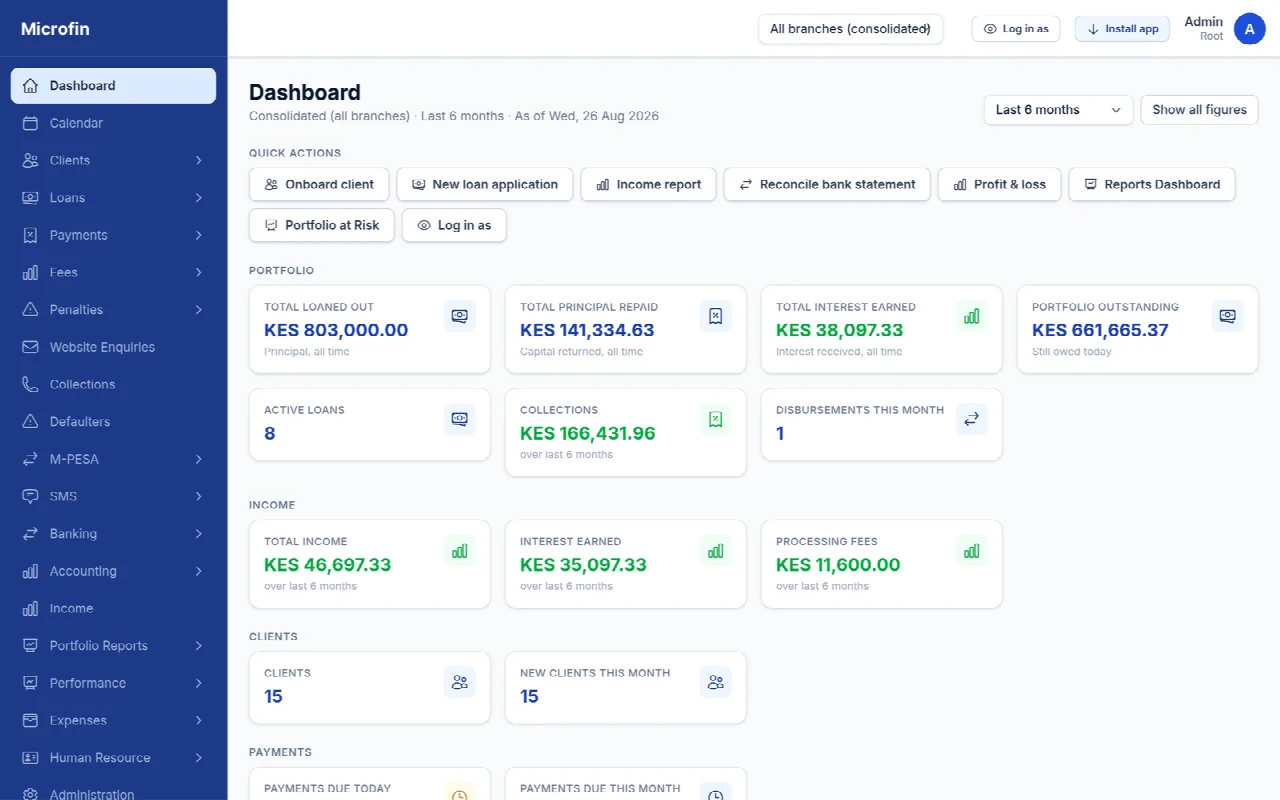
A look inside the dashboard your team works in every day.
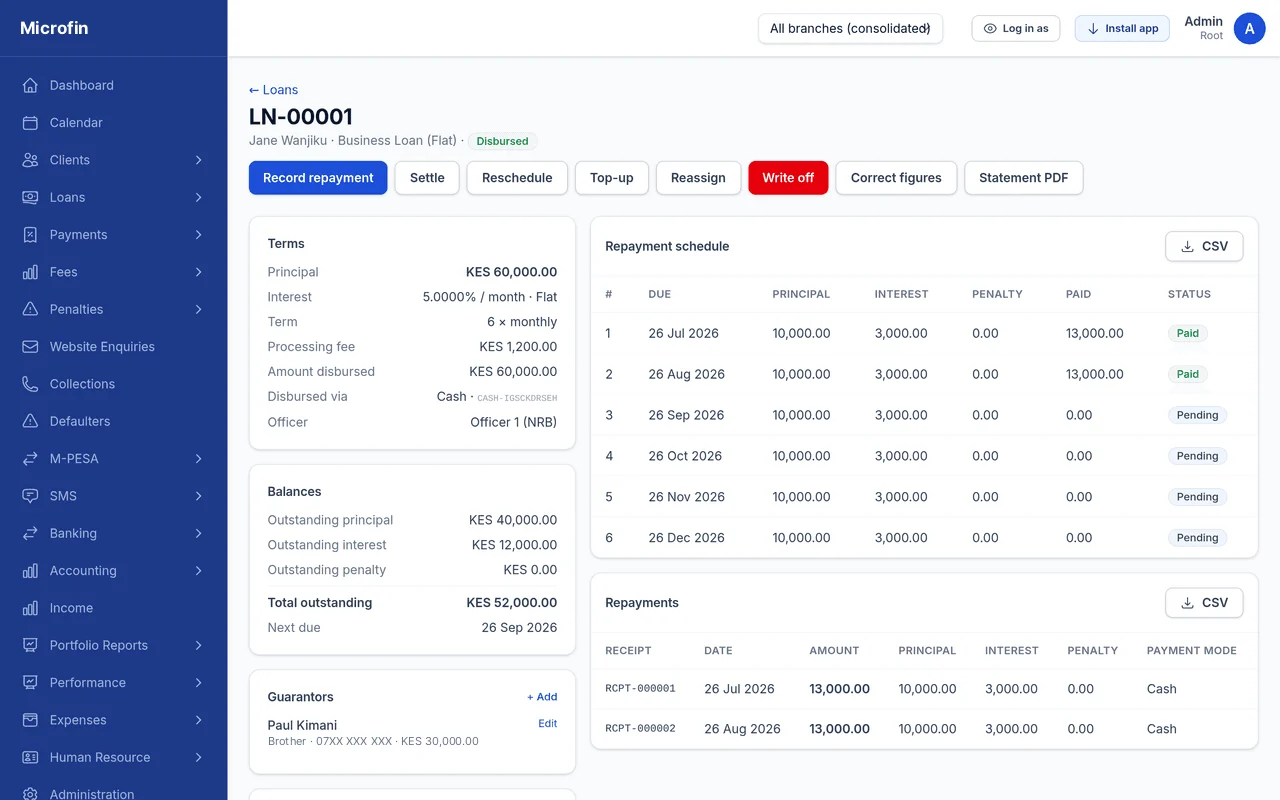
Origination & approvals
Application through the approval queue to disbursement, with the schedule, fees and guarantors fixed at the moment money leaves.
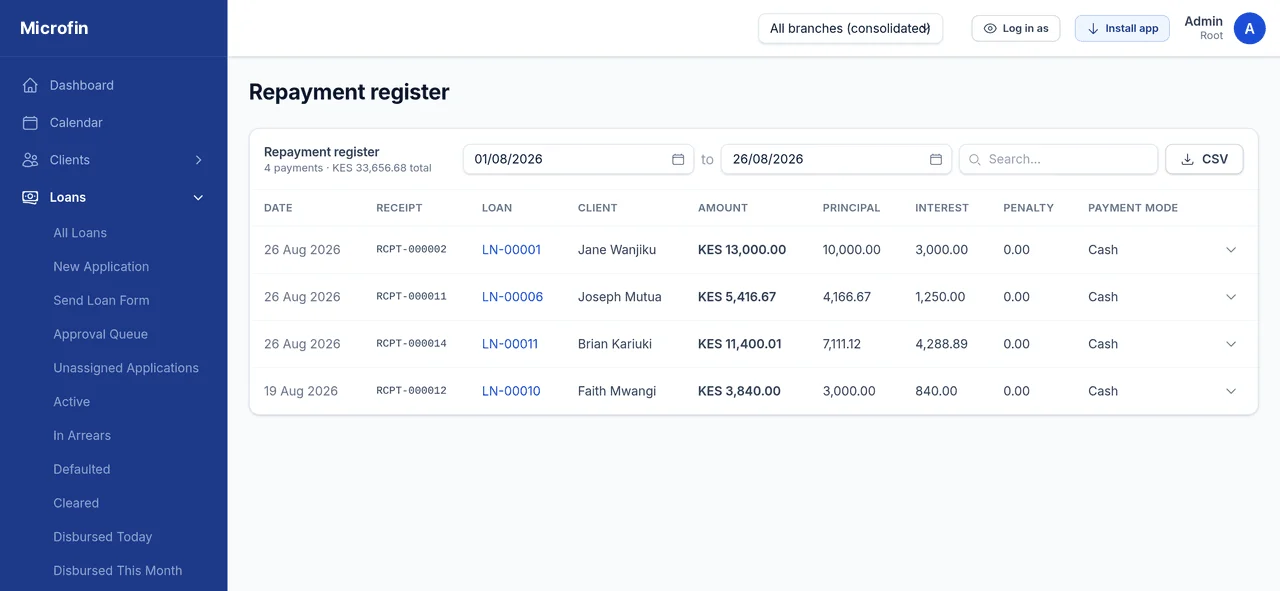
Repayments
The repayment register, with principal, interest and penalty split per receipt and the payment mode — cash, bank or M-PESA — on every line.
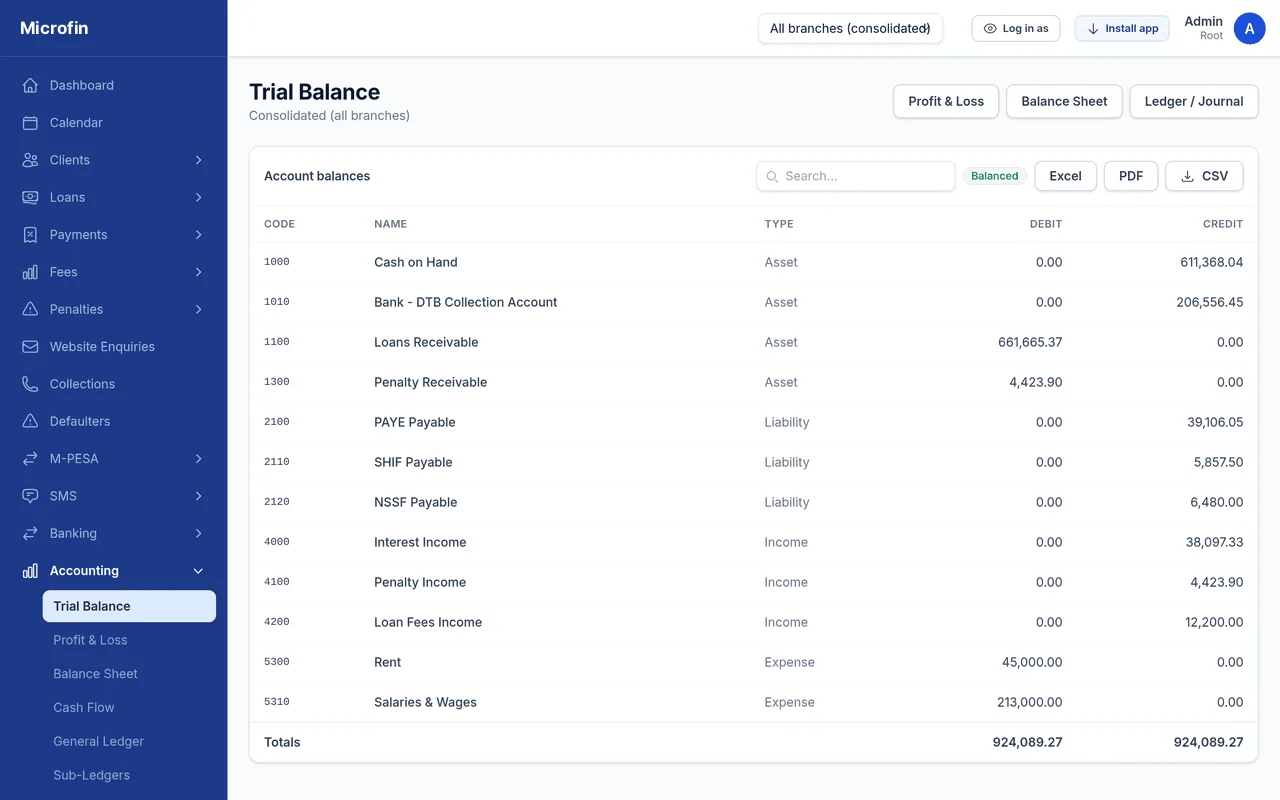
Accounting
Trial balance, profit & loss, balance sheet and cash flow — balanced, and consolidated across branches.
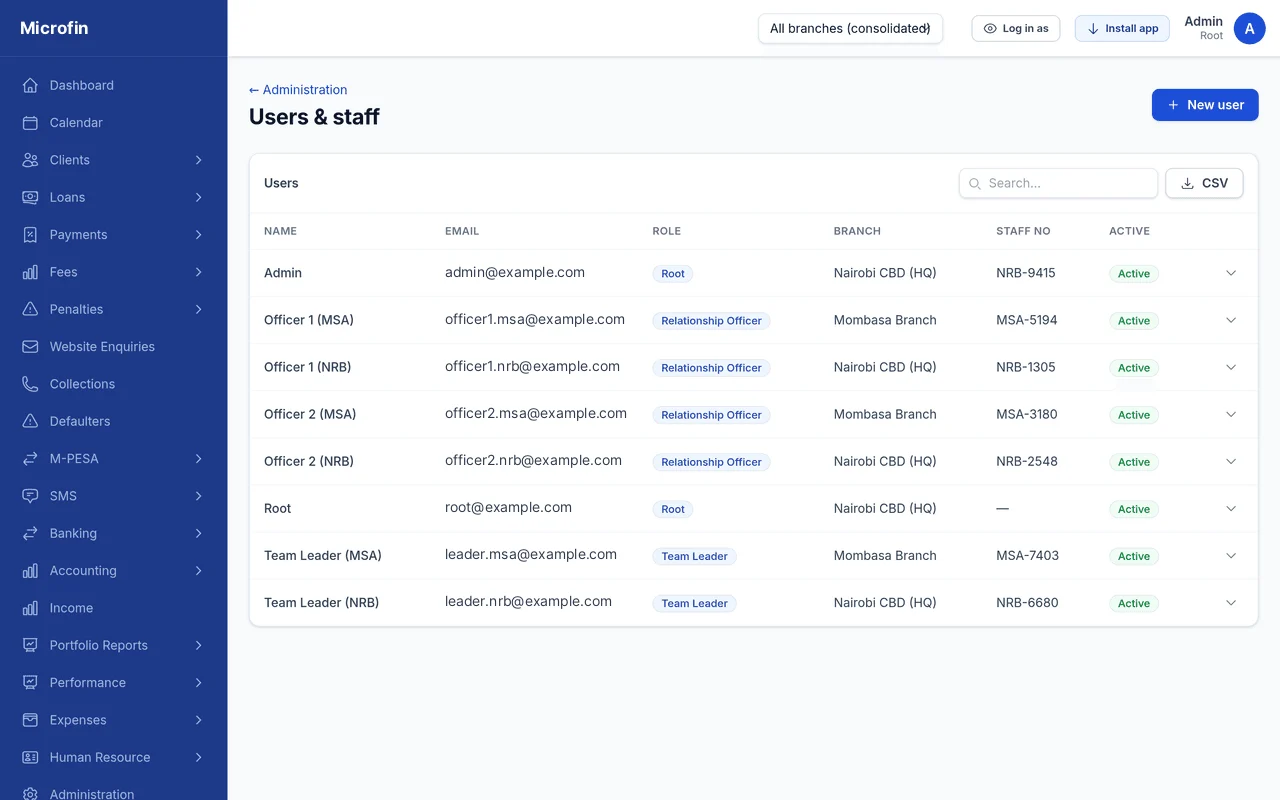
People & branches
Roles, granular permissions and branch scoping on every account, with officer targets measured against the book itself.
Everything Microfin can do
Purpose-built features for real-world results.
Origination & maker-checker approvals
Application to disbursement with the officer who creates a payout never being the one who releases it — flat or reducing balance, any term, fees and penalties set per product.
M-PESA Daraja C2B & B2C
Paybill payments matched to the loan and journalled automatically; approved loans disbursed to the borrower's M-PESA number from inside the system.
Real double-entry accounting
Chart of accounts, journals, general ledger, trial balance, P&L, balance sheet and cash flow — every disbursement, fee, penalty and payroll run posts its own journal.
Bank reconciliation & suspense
Import the bank statement and reconcile it line by line against the ledger. Unmatched lines stay visible in suspense until a human decides what they were.
Branch & officer scoping
Portfolios scoped by branch and officer at the query layer, with head office seeing the consolidated position on the same screen and the same definitions.
A database per lender
Each customer gets their own MySQL database and a user granted on that database alone — isolation proved against MySQL rather than asserted in a query.
Built for the teams who rely on it
Microfin fits the way real Kenyan organisations work.
Microfinance companies
Run origination, disbursement, repayments, penalties and collections on one book that balances — across every branch.
SACCOs
Member loans and savings posted to a real general ledger, with branch and officer scoping applied at the query rather than the menu.
Digital & asset lenders
Daraja C2B collections and B2C disbursement on your own shortcode, with unmatched payments held in suspense instead of guessed at.
What you can do with Microfin
The paybill payment finds its own loan
A payment carrying a recognisable account number is matched to the loan, applied to the schedule in order and journalled — in one movement, with nobody typing it.
Month end that already reconciles
Every disbursement, repayment, fee, penalty, expense and payroll run writes its own journal as it happens, so the trial balance is a consequence of the month rather than a reconstruction of it.
Every branch on the same definitions
An officer sees their own clients, a team leader their branch, head office the consolidated position — one screen, one set of definitions, no rebuilt spreadsheets.
Common questions about Microfin
Microfin is priced in shillings and printed on the page. Starter is KES 2,500 per month for one branch, up to 5 users and up to 500 active loans. Growth is KES 4,500 per month for up to 5 branches, 25 users and 5,000 active loans, and adds M-PESA B2C disbursement, bank reconciliation, SMS, group lending and payroll. Enterprise starts at KES 5,000 per month for unlimited branches and users, with direct debit collections, your own branded public site and API access. There is also a one-off perpetual licence for lenders who would rather buy it once and run it themselves — priced on your book size and where it is hosted. Billing is monthly in KES and you can cancel at any time.
Yes, for paybill collections. The Daraja C2B callback is registered against your own shortcode, so Safaricom delivers each payment as it happens. A payment carrying a recognisable account number is matched to the loan, applied to the schedule in order and posted to the ledger without anyone typing it. Payments that cannot be matched go to a suspense list for a human to decide rather than being guessed at, and cancellations and reversals are handled as reversals, never as deletions — so the audit trail of a disputed figure survives the dispute.
Yes. SACCOs, microfinance companies and digital lenders all run the same core: client onboarding and KYC, loan origination with maker-checker approvals, disbursement, repayment schedules on flat or reducing balance, penalties and arrears, savings, collections and a full general ledger. Branches are an internal dimension inside your organisation, so a multi-branch SACCO gets per-branch books and a consolidated head-office view on the same screen, with the same definitions.
You do. It is your loan book, your clients and your ledger, and you can export the whole of it at any time — including while an invoice is unpaid, because a regulated business's records should never be held hostage over a bill. If you leave, you get a full export and your database is destroyed on a schedule put in writing. Every screen that shows figures also exports to Excel, PDF or CSV for your auditor.
Each customer gets their own MySQL database and their own database user, granted on that database only, and the application connects as that user. That is deliberately not the usual approach — one shared database with a customer column on every table is one bug in one query away from showing your book to somebody else. Here the boundary holds at the database even when the application layer is wrong: that connection cannot list another customer's database, let alone read one, and it was tested against MySQL rather than assumed.
Usually yes. We migrate clients, active loans with their outstanding balances and schedules, repayment history, and opening balances for the chart of accounts. It is scoped first against a copy of your data and quoted separately — a migration priced blind is a migration that goes wrong, so we will not pretend it is free or instant.
Four, described precisely rather than claimed vaguely. M-PESA Daraja C2B for paybill or till collections on your own shortcode, with credentials stored encrypted. M-PESA Daraja B2C for disbursement out to the borrower, requiring a B2C shortcode and Safaricom source-IP whitelisting. DTB bank statement import and reconciliation against the ledger, with other banks by statement import and direct feeds on request. And SMS through your own TextSMS or Advanta account and sender ID, billed by your provider at their rate — Microfin does not resell SMS or add a margin. Direct debit collections are available on Enterprise, subject to your bank's mandate process.
Microfin is built and run by Edgecom Web Solutions in Nairobi — the same team behind HostingKE, Edgecom CRM, School Manager, QueueChat and EstateOps. Support is local, during Kenyan business hours, from people who worked on the system itself. Enterprise customers get a named contact and a migration plan with dates on it. Request a demo and you get a 30-minute walkthrough on your own numbers — no card, no obligation.
Related products from Edgecom
Edgecom CRM
saasRun the whole customer journey — leads, quotes, invoices, payments and jobs — in one system.
Edgecom CRM is the complete customer-management and billing platform for Kenyan businesses. One connected system owns the full commercial journey — from first enquiry, through quotations, invoices, payments, receipts and job delivery — so no information is ever entered twice and no document is ever manually assembled. A quotation becomes an invoice in one action with nothing retyped, a paid invoice issues its receipt automatically, and every client carries a permanent, searchable history. Built for how businesses in Kenya actually work: multi-currency totals (KES, UGX and more) exact to the cent with VAT, discounts and conversions that never drift, M-Pesa-ready payment recording with automatic reconciliation, and role-based access so sales, finance, designers and management each see only what they should. Fully supported by a real Nairobi-based team, with onboarding, training and branded PDF documents included.
Learn moreQueueChat
saasThe WhatsApp CRM for Kenyan businesses.
QueueChat turns WhatsApp into a complete sales and support platform for Kenyan businesses. Every customer message lands in one shared team inbox, new contacts become leads automatically, and smart keyword auto-replies — in English and Swahili — answer common questions instantly, so nothing slips through the cracks. Beyond the inbox, QueueChat adds a support-ticket helpdesk with SLAs and auto-routing, a lead pipeline, contact management and real-time analytics. The WhatsApp Business API is fully managed for you, so you can sign up, connect a number and start messaging in minutes — with no Meta configuration required.
Learn moreEstateOps
saasThe real-estate sales CRM built for Kenyan agencies.
EstateOps is a multi-tenant real-estate CRM for property and letting agencies across Kenya and Africa. It unifies every lead source — WhatsApp, Facebook Lead Ads, web forms, walk-ins and referrals — with automatic duplicate detection, then scores and routes each lead to the right agent in seconds. From a single dashboard, teams run their entire sales pipeline: template-driven WhatsApp and SMS follow-up sequences, a public viewing scheduler with automated reminders, property listings, and real-time analytics on source ROI, conversion and agent performance. Each agency gets its own white-label space with custom branding, role-based access and M-Pesa subscription billing.
Learn moreReady to try Microfin?
Setup is quick — most clients are live within a week. Tell us how your team works and we'll show you the fit.